
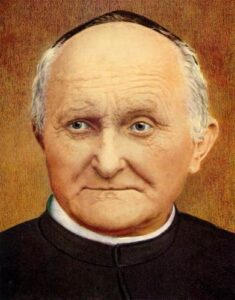
St Arnold Janssen
Founder of the Society of the Divine Word
Certainly. Below is an elaborative, school-friendly profile of St. Arnold Janssen, suitable for a school project, assembly, brochure, magazine, display board, speech, or presentation.
St. Arnold Janssen
Founder of the Society of the Divine Word (SVD)
St. Arnold Janssen (1837–1909) was a German Catholic priest, missionary visionary, educator, publisher and founder of the Society of the Divine Word (SVD), commonly known as the Divine Word Missionaries. He dedicated his life to spreading the Gospel and awakening missionary responsibility in the Church. He was canonized as a saint by Pope John Paul II on 5 October 2003. Vatican
His life can be summed up through three important ideas: faith in God, missionary service and dedication to God’s will.
1. Early Life
St. Arnold Janssen was born on 5 November 1837 in Goch, a small town in the Lower Rhineland of Germany. He was the second of ten children in a deeply religious family. His parents gave him a strong foundation of faith and devotion. Vatican
From an early age, Arnold showed an interest in the priesthood. He studied at Gaesdonck and later pursued studies in philosophy, theology, mathematics and natural sciences. His education helped him develop both a strong intellectual foundation and a deep spiritual life.
He was ordained a priest for the Diocese of Münster on 15 August 1861. After his ordination, he worked as a teacher of mathematics and natural sciences in Bocholt. He became known as a disciplined and fair teacher. Vatican
2. His Growing Missionary Vision
Although Arnold Janssen was a teacher and diocesan priest, his vision gradually expanded beyond his local surroundings.
His devotion to the Sacred Heart of Jesus and his work with the Apostleship of Prayer helped him develop a strong concern for the spiritual needs of people throughout the world. He became increasingly convinced that Christians had a responsibility to support the missionary work of the Church. Vatican
At that time, Germany was experiencing the Kulturkampf, a period of serious conflict between the German state and the Catholic Church. Religious institutions and clergy experienced restrictions and persecution.
Rather than seeing these difficulties simply as obstacles, Janssen began thinking about how the situation could become an opportunity to strengthen missionary activity.
He wanted to create a place where missionaries could be trained, formed spiritually and sent to places where the Gospel had not yet been sufficiently proclaimed.
3. The Little Messenger of the Sacred Heart
Before founding the Society of the Divine Word, Arnold Janssen understood the importance of communication.
In 1873, he resigned from his teaching position and became increasingly involved in missionary awareness. He founded a publication called The Little Messenger of the Sacred Heart.
Through this magazine, he shared information about missionary work and encouraged Catholics, particularly in German-speaking regions, to support missions around the world. Vatican
This shows one of the important characteristics of his approach: he believed that missionary work required not only missionaries in distant countries but also people at home who prayed, learned about missions and supported them.
4. Founding of the Society of the Divine Word
The most important achievement of St. Arnold Janssen’s life was the establishment of the Mission House at Steyl in the Netherlands.
On 8 September 1875, Janssen inaugurated the mission house at Steyl, near the German border. This became the birthplace of the Society of the Divine Word. Vatican
At first, the idea faced considerable doubt. Some people questioned whether Janssen was the right person to undertake such a difficult project and whether the time was suitable.
But Janssen trusted in Divine Providence.
His response to difficulties reflected his profound faith:
“The Lord challenges our faith to do something new, precisely when so many things are collapsing in the Church.” SVD Curia
The small mission house gradually developed into an international missionary congregation.
5. The Meaning of the Society of the Divine Word
The Society of the Divine Word, abbreviated SVD, was established for missionary service and the proclamation of the Gospel.
The expression “Divine Word” has a special Christian meaning. It refers to Jesus Christ, the Word made flesh, and also to the Word of God proclaimed through Sacred Scripture.
The SVD identifies the proclamation of God’s Word as central to its missionary identity. Its official materials describe the proclamation of the Word of God as its foremost obligation. SVD Curia
The missionaries were prepared to work across cultures and nations, especially among people and communities where the Gospel was less known.
6. The First Missionaries
One of the early milestones of the new congregation occurred on 2 March 1879, when the first two missionaries were sent to China. One of them was Joseph Freinademetz, who later became St. Joseph Freinademetz. Vatican
This was the beginning of a missionary tradition that would eventually extend across continents.
The first mission in China later became an important part of SVD history, and the congregation gradually expanded its missionary presence internationally.
7. Importance of Education and Printing
St. Arnold Janssen understood that missionary work required education, communication and formation.
Only a few months after opening the mission house, he established a printing press. Publications helped spread missionary information, encourage vocations and obtain financial support for missionary work. Vatican
This was significant because Janssen recognized the power of modern communication in evangelization.
His approach included:
- Education
- Religious formation
- Printing and publications
- Missionary animation
- Training of priests and brothers
- Communication about missionary activities
- Spiritual and material support for missions
Thus, his missionary vision was broader than simply sending priests to foreign countries.
8. His Vision Included Priests and Brothers
St. Arnold Janssen’s missionary community was not limited to priests.
From the early years, the Society developed as a community including priests and Brothers. Brothers contributed through practical work such as printing, construction, administration, technical services and support of mission institutions. SVD Curia
This reflected an important principle in Janssen’s vision:
Mission is a shared responsibility.
Different people could contribute according to their gifts and vocation.
9. Founding of the Missionary Sisters
St. Arnold Janssen also recognized the important contribution women could make to missionary work.
In 1889, he founded the Missionary Servants of the Holy Spirit (SSpS), a congregation of missionary women. The first Sisters eventually went to Argentina in 1895. Vatican
Among the women associated with this missionary foundation were Blessed Maria Helena Stollenwerk and Blessed Josepha Hendrina Stenmanns.
Janssen’s missionary vision therefore developed into a wider spiritual family involving priests, brothers and sisters.
10. Servants of the Holy Spirit of Perpetual Adoration
In 1896, another important branch was established: the Servants of the Holy Spirit of Perpetual Adoration (SSpSAP).
Their particular mission was contemplative prayer and continuous adoration of the Blessed Sacrament, praying for the Church and especially for missionaries engaged in active apostolic work. Vatican
This demonstrates an important aspect of Janssen’s spirituality:
Active mission and prayer belong together.
For him, missionaries needed both action and prayer.
11. His Spirituality
The spirituality of St. Arnold Janssen was strongly centered on the Holy Trinity, the Incarnation, the Word of God, the Sacred Heart of Jesus and the Holy Spirit. SVD Curia
Some important characteristics of his spirituality were:
Faith in Divine Providence
Arnold trusted that God would provide what was necessary for the mission.
Love for the Word of God
He believed that the Gospel had to be proclaimed to all peoples.
Devotion to the Holy Spirit
He emphasized the role of the Holy Spirit in guiding the Church and missionary activity.
Love for the Sacred Heart of Jesus
His devotion to the Sacred Heart strongly influenced his missionary spirituality.
Prayer
He believed that missionary activity had to be supported by prayer.
Hard Work
His life demonstrated that faith should be accompanied by disciplined and practical work.
Missionary Spirit
He wanted the Church to become increasingly aware of its universal missionary responsibility.
12. His Trust in Divine Providence
One of the most remarkable qualities associated with St. Arnold Janssen was his confidence in Divine Providence.
His project began with very limited resources. Yet he continued working despite criticism, financial difficulties and uncertainty.
The SVD describes him as an ordinary person who intensely sought to understand and follow God’s will. His life combined prayer, perseverance, sacrifice and practical work. SVD Curia
This gives an important lesson for students:
Great things can begin with a small step when that step is taken with faith, courage and perseverance.
13. His Character
St. Arnold Janssen was not presented as someone who accomplished everything instantly. His story is one of gradual growth.
Important characteristics associated with him include:
- Faith
- Perseverance
- Courage
- Discipline
- Humility
- Prayerfulness
- Missionary zeal
- Trust in God
- Organizational ability
- Concern for education
- Commitment to service
His life demonstrates how a person can transform a spiritual conviction into an organized mission serving people across cultures.
14. His Death
St. Arnold Janssen died on 15 January 1909 at Steyl, Netherlands. His life had been characterized by his search for God’s will, confidence in Divine Providence and tireless work. Vatican
By the time of his death, the missionary communities he had founded had already developed significantly.
His work continued through the missionaries, Sisters and Brothers who carried his vision into different countries and cultures.
15. Beatification and Canonization
Arnold Janssen was beatified by Pope Paul VI in 1975.
On 5 October 2003, Pope John Paul II canonized him as Saint Arnold Janssen in Rome, together with St. Joseph Freinademetz and St. Daniel Comboni. Vatican
During the canonization homily, Pope John Paul II highlighted Janssen’s tireless missionary work and his use of the press and other means of communication to spread the Gospel. Vatican
16. St. Arnold Janssen and the Society of the Divine Word Today
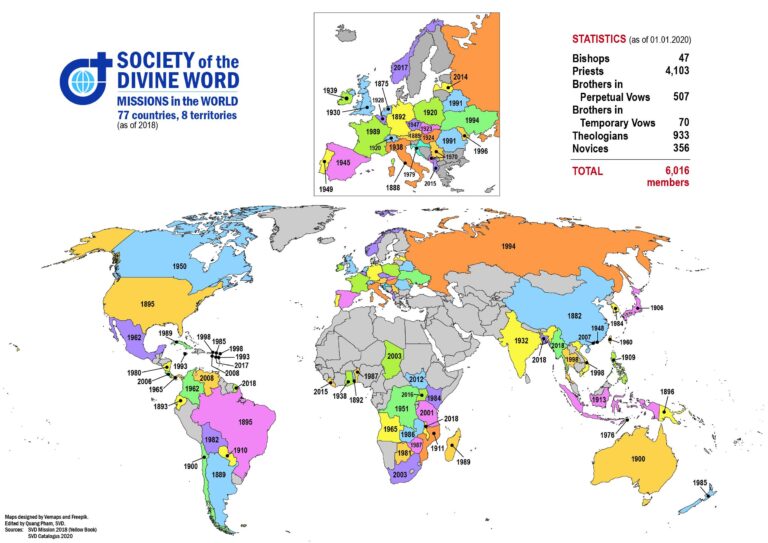
The congregation that began in a small mission house in Steyl has become an international missionary community.
The Society of the Divine Word celebrated its 150th anniversary in 2025, marking 150 years since its foundation in 1875. The SVD reported nearly 6,000 members serving in 79 countries at that time. SVD Curia
Today, Divine Word Missionaries are involved in areas including:
- Evangelization
- Parish ministry
- Education
- Formation of seminarians
- Biblical apostolate
- Mission animation
- Communications
- Social and community development
- Justice, peace and care for creation
- Intercultural and interreligious dialogue
The congregation’s international character reflects something that was already present in its beginnings: missionary service across national and cultural boundaries. SVD Curia
17. St. Arnold Janssen’s Educational Vision
For a school such as St. Arnold’s Co-Ed School, his educational legacy is particularly meaningful.
Janssen himself had been a teacher of mathematics and natural sciences. His life demonstrates that education and faith can work together in forming the whole person.
His example encourages education that develops:
Knowledge + Character + Faith + Service + Responsibility
A school inspired by St. Arnold Janssen can therefore aim not merely to produce academically successful students, but young people who are:
- Responsible citizens
- Compassionate human beings
- Respectful toward different cultures
- Committed to truth
- Willing to serve others
- Spiritually grounded
- Open to the needs of society
18. Lessons We Can Learn from St. Arnold Janssen
1. Have faith in your mission
A meaningful project may begin small, but faith and dedication can help it grow.
2. Do not be discouraged by difficulties
Janssen faced criticism and uncertainty, yet continued working.
3. Education is powerful
His own experience as a teacher influenced his approach to missionary formation and education.
4. Service should cross boundaries
His missionary vision was universal and embraced different cultures and nations.
5. Prayer and action must go together
He established both active missionary communities and a congregation dedicated to perpetual prayer.
6. Use modern communication for good
His use of printing and publications shows the importance of communication in spreading positive ideas.
7. Respect every culture
The international development of the SVD reflects the importance of working with people from different cultural backgrounds.
8. Trust in Divine Providence
His life is remembered especially for his confidence that God could work through ordinary people.
19. A Short Timeline
| Year | Event |
|---|---|
| 1837 | Born in Goch, Germany |
| 1861 | Ordained a priest |
| 1873 | Left teaching and became more actively involved in missionary awareness |
| 1873 onward | Promoted missionary awareness through The Little Messenger of the Sacred Heart |
| 1875 | Founded the Mission House at Steyl, beginning the Society of the Divine Word |
| 1879 | First SVD missionaries sent to China |
| 1889 | Founded the Missionary Servants of the Holy Spirit |
| 1896 | Founded the Servants of the Holy Spirit of Perpetual Adoration |
| 1909 | Died at Steyl |
| 1975 | Beatified by Pope Paul VI |
| 2003 | Canonized by Pope John Paul II |
| 2025 | Society of the Divine Word celebrated 150 years of missionary service |
20. St. Arnold Janssen’s Message for Young People
For today’s students, the life of St. Arnold Janssen can be understood through a simple message:
Dream with faith, work with dedication, serve with love, and never give up when difficulties arise.
He began with a vision that many people initially considered difficult or unrealistic. Through perseverance, prayer, organization and trust in God, that vision developed into an international missionary movement.
His life therefore reminds young people that one person’s commitment can become a source of service and inspiration for thousands of others.
A memorable description for a school display
ST. ARNOLD JANSSEN – A MAN OF FAITH, MISSION AND SERVICE
Born: 5 November 1837, Goch, Germany
Ordained: 15 August 1861
Founded SVD: 8 September 1875, Steyl, Netherlands
Founded SSpS: 1889
Founded SSpSAP: 1896
Died: 15 January 1909
Canonized: 5 October 2003
Founder of the Society of the Divine Word – SVD
His vision:
“To proclaim the Word of God and serve people across cultures and nations.”
St. Arnold Janssen’s legacy continues through the Society of the Divine Word and the two congregations of women he founded, making his life especially significant for institutions committed to faith, education, missionary spirit and service. Vatican
For an official reference, the Society of the Divine Word’s Founder and Cofounders page and the Vatican biography of St. Arnold Janssen are useful sources.